

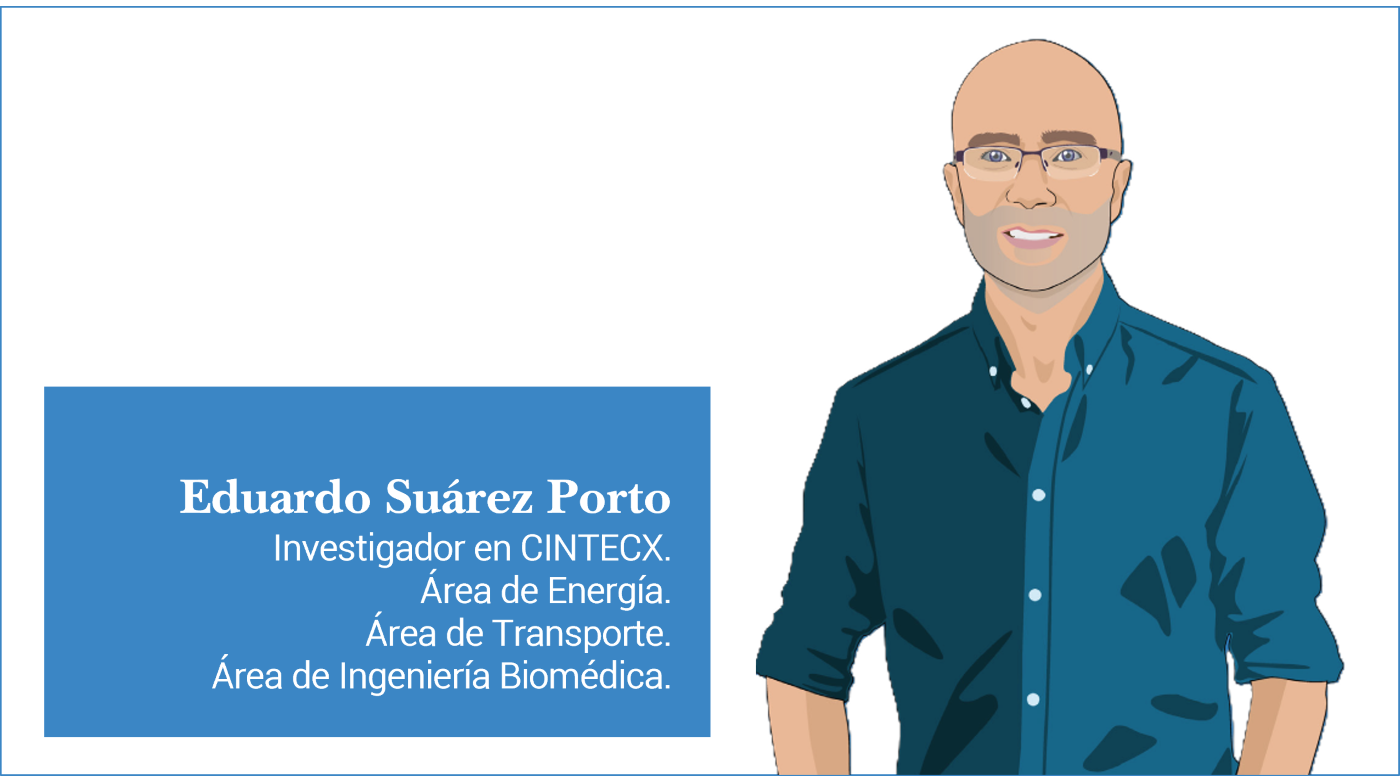
The Centre for Research in Technologies, Energy and Industrial Processes (CINTECX) dedicates the month of June to Eduardo Suárez Porto, a researcher in the Energy Technologies Group (GTE), who is featured in its illustrated calendar and is the latest voice in the CINTECX Open Camera for Women and Men in STEM initiative.
Suárez Porto works in the field of fluid simulation, a research area that he has applied to sectors as diverse as the automotive industry, biomedicine, and the aerodynamics of high-speed trains. “I started in the industrial sector and have gradually moved into new fields, but always within simulation,” he explains.
His entry into research was not driven by an early vocation. “It wasn’t something I was looking for. I finished my degree, a grant came up, and before you know it, you find yourself on the research career path,” he says.
In contrast, he was certain that he wanted to start a family. He admits that this decision completely transformed the way he worked. “Before having children, my schedule ran from eight in the morning until nine at night. Afterwards, everything changes: you have to reorganize yourself and manage your time very carefully,” he states.
Work-Life Balance and Flexibility: A Race Against Time
Far from viewing work-life balance as a sacrifice, Suárez Porto proposes a different perspective: “The question is not whether your personal life harms your professional career, but the other way around.” In his case, he argues that prioritizing family is a conscious decision. “If my professional goals are delayed by one or two years because of having children, that is perfectly fine with me,” he says.
Daily organization is crucial. “My personal and professional lives are completely intertwined,” he explains. “I need to plan almost hour by hour; otherwise, everything falls out of place.” His schedule combines teaching duties, research projects, and family commitments, even color-coded to distinguish essential tasks from flexible ones.
As the father of two children, he highlights that flexible working hours have been essential in allowing him to balance both spheres. “I can adapt my working day: if I need to leave earlier one day, I make up the time at night or over the weekend,” he explains. However, this advantage is not always available in other professional settings. “In my case, being able to make that arrangement has been fundamental.”
The researcher also acknowledges that work-life balance does not affect men and women equally. “In my environment, it is clear that women give up more of their professional careers,” he notes. Although the impact on his own scientific output has been limited—“there is only one year without publications, which coincides with the birth of my daughter”—he admits that many female researchers face an “enormous additional effort” to avoid falling behind.
In this context, he values the measures promoted in recent years by the University of Vigo, although he believes they still need to be consolidated and expanded. Among his proposals are greater flexibility, services such as childcare facilities on campus, and reducing activities scheduled in the afternoon. “Avoiding afternoon meetings or concentrating the working day into a more European timetable would help a great deal,” he maintains.
As a final message, Suárez Porto stresses the importance of continuing to advance work-life balance measures within the scientific system. “Any measure in this direction is welcome,” he concludes. “Flexibility is key and, moreover, it benefits both men and women and contributes to greater equality in research careers.”