

DUVI 05/06/2026
Nearly one million euros secured and six projects awarded. These are the results achieved by the University of Vigo in the 2025 Proof of Concept call of the Spanish State Research Agency (AEI), an initiative aimed at facilitating technology transfer and the valorisation of research results. The University of Vigo ranks sixth in success rate in this edition and will be able to test the technical and commercial viability of advances from six lines of work—mainly from Cintecx—ranging from additive manufacturing of glass to oxidant encapsulation, new antibiotics, road safety, detection and geolocation systems, and intelligent management of network resources.
This call, part of the State Programme for Transfer and Collaboration within the 2024–2027 National Research Plan, aims to fund actions that validate the technical and commercial feasibility of previous discoveries, serving as a bridge between scientific research carried out in research centres and its potential practical application in the market or society. Through these grants, research groups can demonstrate the innovation potential of their ideas, facilitating their subsequent exploitation by the business or social sector. In total, UVigo submitted 23 projects to this highly competitive call, of which six were approved (five led by Cintecx researchers and one by atlanTTic), amounting to €923,351 in funding.
Overall, the AEI awarded 183 projects, with a total budget of €29.8 million. Of these, 67% correspond to applications submitted by researchers affiliated with universities—122 public and one private—across 16 autonomous communities. Regarding the distribution of grants by region, Madrid leads with 42 approved Proof of Concept projects, followed by Catalonia with 38, Andalusia with 22, and Galicia with 19.
bOROMorph
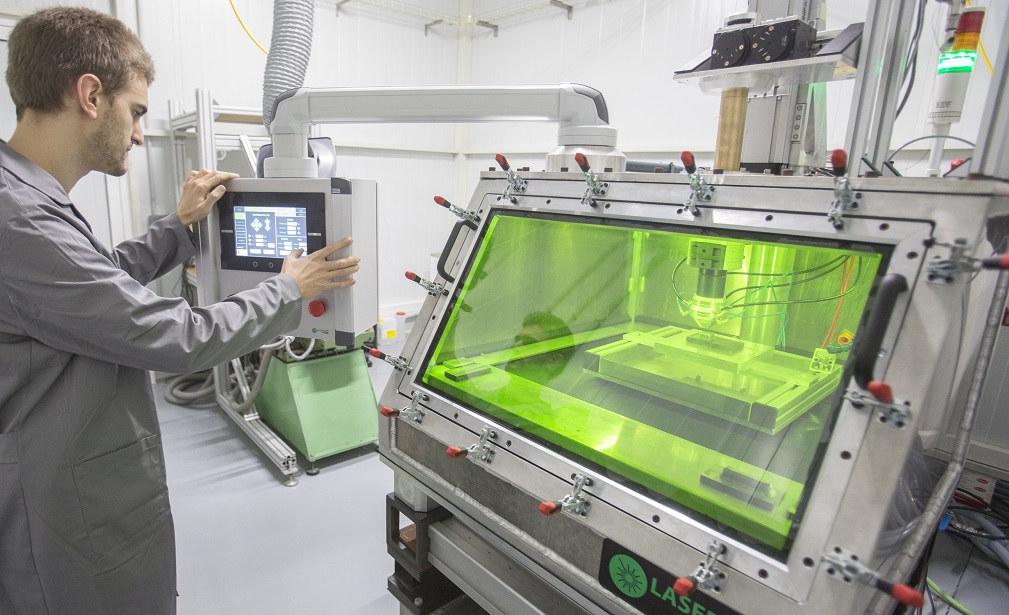
bOROMorph is one of the UVigo projects selected in this edition. Led by Cintecx researcher Rafael Comesaña and awarded €145,200, it aims to validate technically, financially, and commercially a new additive manufacturing technology for glass and ceramics based on laser-directed energy deposition. This technology was previously developed in the glADDmorph project, which produced a prototype capable of processing these materials in a versatile and unprecedented way, overcoming the limitations of current techniques. With this proof of concept, the team seeks to significantly increase the technological and commercial readiness level of the solution, secure intellectual property protection, and validate the prototype in a relevant environment using sustainable materials derived from pharmaceutical glass waste and technical glass-ceramics.
Hybox
Another project selected by the State Research Agency is Hybox, which aims to develop and validate a hybrid oxidant encapsulation system for the sustainable treatment of environments contaminated with persistent organic compounds—difficult to degrade naturally and hazardous to public health and the environment. The project is led by Cintecx researchers Marta Pazos and Ángeles Sanromán, who will receive €183,920. The proposal is based on biodegradable agar-agar capsules coated with polyacrylonitrile, capable of releasing oxidants such as persulfate, peroxymonosulfate, and calcium peroxide in a controlled manner, improving the efficiency of advanced oxidation processes and reducing reagent consumption and toxic by-product generation. Hybox builds on the previous Resihosp project, optimising the formulation, validating its effectiveness under real conditions, and promoting its technological transfer and commercialisation.
Proofgramicin
Tamén impulsado por investigadores do Cintecx, foi seleccionado o proxecto Proofgramicin, baseado na tecnoloxía desenvolvida no marco do proxecto Gramicorn, centrado na produción e extracción a escala piloto de novos antibióticos a partir dunha cepa de Aneurinibacillus aneurinilyticus illada do ‘corn steep liquor’ (CSL). Ana Belén Moldes e José Manuel Cruz coordinan esta iniciativa, que contará cunha axuda de 174.240€. Os traballos previos permitiron descubrir varios homólogos novidosos de Gramicidina S, así como a propia Gramicidina S, producidos con alta reproducibilidade en CSL e en medios sintéticos e publicados en revistas indexadas e congresos internacionais. O antibiótico desenvolvido está libre de ácido trifluoroacético (TFA) e contén análogos con pequenas modificacións nos aminoácidos, alcanzando unha pureza do 90% e maior eficacia que a Gramicidina S comercial. Entre os obxectivos destacan o escalado da produción e extracción mediante métodos sostibles, a validación das propiedades antibióticas a escala piloto, a protección da tecnoloxía con patentes internacionais e a colaboración coa industria e institucións. O proxecto busca combater a resistencia aos antibióticos, promover a produción sostible, mellorar a saúde pública mediante antibióticos máis seguros e efectivos, reducir custos sanitarios e minimizar residuos perigosos.
RoadCARE
Also driven by Cintecx researchers, the Proofgramicin project was selected based on technology developed within the Gramicorn project, focused on the pilot-scale production and extraction of new antibiotics from a strain of Aneurinibacillus aneurinilyticus isolated from corn steep liquor (CSL). The initiative is coordinated by Ana Belén Moldes and José Manuel Cruz and will receive €174,240. Previous work led to the discovery of several novel homologues of Gramicidin S, as well as Gramicidin S itself, produced with high reproducibility in CSL and synthetic media, and published in indexed journals and international conferences. The developed antibiotic is free of trifluoroacetic acid (TFA) and contains analogues with small amino acid modifications, achieving 90% purity and greater efficacy than commercial Gramicidin S. Objectives include scaling up production and extraction using sustainable methods, validating antibiotic properties at pilot scale, protecting the technology through international patents, and collaborating with industry and institutions. The project aims to combat antibiotic resistance, promote sustainable production, improve public health through safer and more effective antibiotics, reduce healthcare costs, and minimise hazardous waste.
Sense4energy
Another approved project is Sense4energy, which aims to develop, validate, and initiate the transfer of a device based on mmWave radar for anonymous detection, counting, and geolocation of people in indoor spaces. This enables real-time estimation of internal loads generated by occupants (heat, humidity, CO₂) and optimisation of HVAC, ventilation, and lighting systems in tertiary buildings such as hospitals, universities, and public offices. The proposal, led by Cintecx researcher Enrique Granada with €121,000 in funding, arises from needs identified in the previous DeepBEM project, which revealed the lack of precise, low-cost, privacy-preserving devices for measuring spatial occupancy. Sense4energy focuses on prototype design and manufacturing, real-environment validation, development of the energy estimation module, integration with HVAC/lighting systems, protection and valorisation of results, and definition of the exploitation strategy. Expected outcomes include 15–30% energy savings, emission reductions, improved indoor comfort, and full GDPR compliance, with a low-cost device (<€150/unit), autonomous communications, and compatibility with industrial protocols. The project plans to exploit the technology through licensing or the creation of a university spin-off.