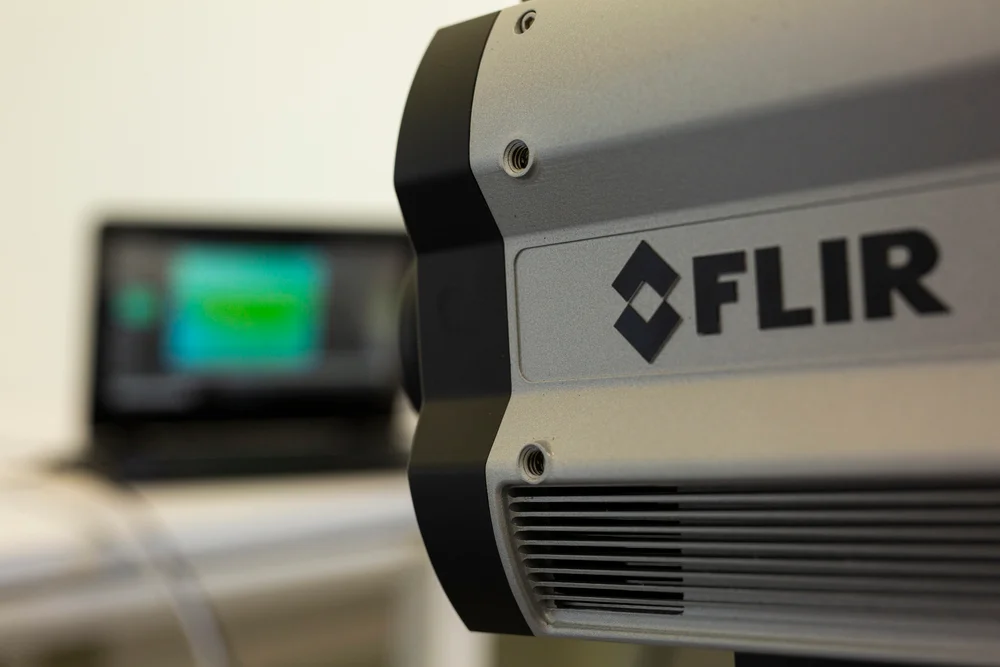
It features a FLIR indium antimonide (InSb) detector and captures full 640 × 512 images at 520 frames per second, or up to 23,077 Hz in windowed mode.
- Pixel size (detector pitch): 25μm.
- Spectral range: 3.0 – 5.0μm (MWIR).
- Thermal sensitivity (NETD): ≤ 20mK (typical).
- Frame rate: from 0.0015 Hz to 520 Hz (adjustable windowing)
- Optional temperature range: 45°C to 600°C (ND1); 250°C to 2000°C (ND2); 500°C to 3000°C (ND3).
- Standard temperature range: from -20 to 300 °C.
- Available optics: 17 mm, 50 mm.
Applications
- Thermal analysis of rapid processes: Impact and fracture of materials. Combustion and detonation processes. Thermal shocks. Laser and arc welding. Dynamics of hot fluids.
- Thermal imaging of materials: Mechanical testing (fatigue, tensile, compression). Mapping of internal defects (active thermal imaging). Characterization of thermal conductivity.
- Aerospace and automotive research: Wind tunnel testing. Heat transfer on aerodynamic surfaces. Thermal behavior of brakes, discs, and pads. Analysis of electric vehicle batteries.
- Electronics and Microelectronics: Thermal mapping of circuits (chips, PCBs). Identification of hot spots. Thermal stress testing. Failure diagnosis of high-power components
- Energy and industry: Gas and steam turbines. Inspection of furnaces, boilers, and refractories. Monitoring of manufacturing processes reaching >1000 °C (with ND filters).