

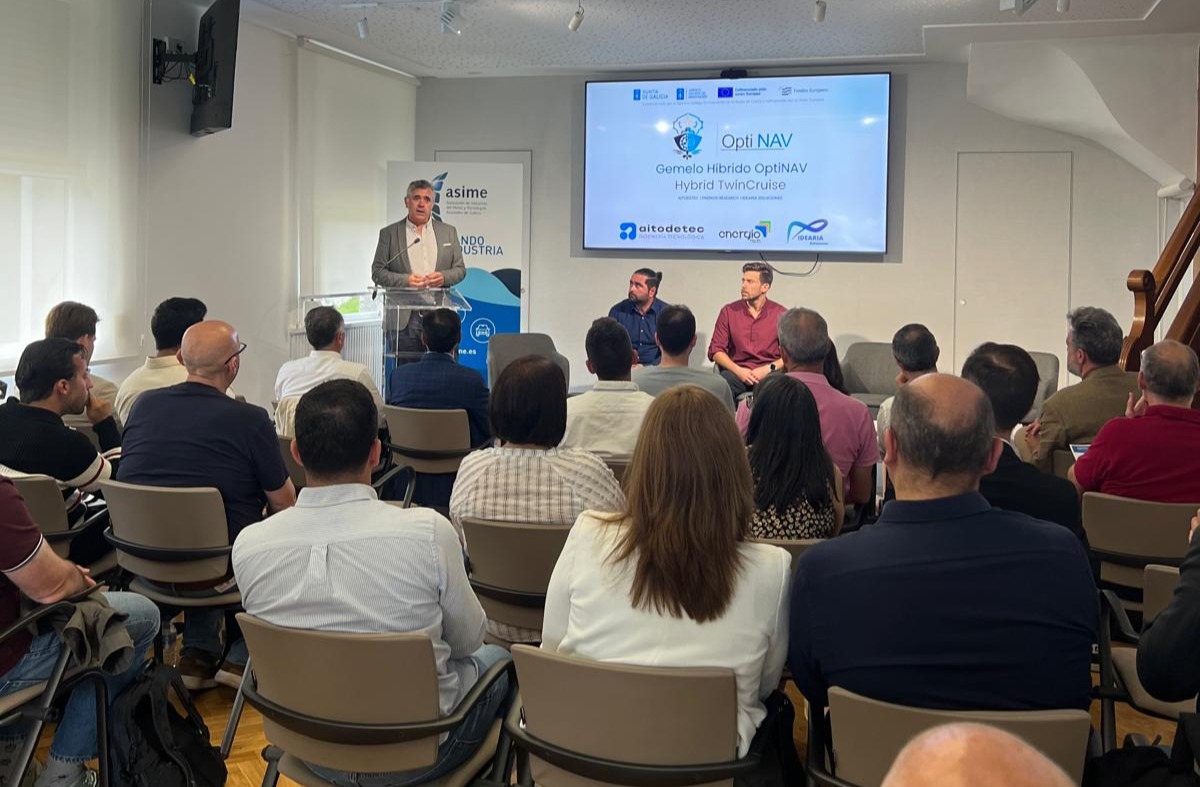
CINTECX research is once again taking a central role in the transfer of knowledge to industry thanks to the cooperation driven by the Nexos programme, an initiative of the Galician Innovation Agency (GAIN) that promotes joint projects between SMEs and agents of the Galician R&D&i system. ASIME hosted a presentation event for these initiatives, attended by representatives from the centre.
During the session, five projects were presented: TRANET, OptiNav Hybrid TwinCruise, BIOLIN, ACUIVAC and CUBia. These initiatives are developed by consortia involving Galician companies in collaboration with universities and research centres, with the aim of transferring scientific knowledge to the productive sector. Representing CINTECX were Jacobo Porteiro, José Luis Míguez, Ángeles Sanromán, Marta Pazos and Pedro Arias, in a meeting that brought together companies, technology centres and research staff to showcase different collaborative R&D&i projects.
Science with the CINTECX hallmark and cooperation with industry
CINTECX’s involvement in this event was reflected in the participation of three of its research groups across five of the projects presented: the Energy Technology Group (GTE), the Applied Geotechnologies Group (GEOTECH), and the Bioengineering and Sustainable Processes Group (BIOSUV). Their contribution focuses on areas such as simulation, data analysis, validation of technologies in real environments, and the development of sustainability-driven solutions.
The GTE group takes part in the TRANET and OptiNav Hybrid TwinCruise projects. TRANET aims to harness waste heat from industrial processes by storing it in molten salts for later reuse, helping to reduce energy consumption. OptiNav Hybrid TwinCruise focuses on improving vessel efficiency through digital twins and predictive control systems, with an emphasis on reducing both fuel consumption and emissions.
In the territorial field, the BIOLIN project addresses biomass management in areas surrounding critical infrastructures such as roads, railways and energy networks, where safety regulations require keeping certain zones clear. Both GEOTECH and BIOSUV contribute to this initiative, providing expertise in geospatial analysis and biomass valorisation.
Meanwhile, CUBia, with involvement from GEOTECH, proposes new methodologies for forest measurement based on technologies such as LiDAR and mobile capture systems, aimed at improving inventories and the management of forest resources. In aquaculture, the ACUIVAC project, also involving GEOTECH, focuses on automating turbot vaccination through robotic systems that integrate computer vision and artificial intelligence, with the goal of improving process accuracy.
The event also included a networking space for exchange between research staff and company representatives, in line with the objective of the Nexos programme: to promote cooperation as a means of developing solutions with direct industrial application. The projects involve a wide range of Galician companies, including Energio Research, Enthalpo Energy Solutions, Industrias Técnicas de Galicia, Feeding Systems, Engranor, Hypnon Programming, Ingeniería Insitu and Exeñería Forestal Asefor