

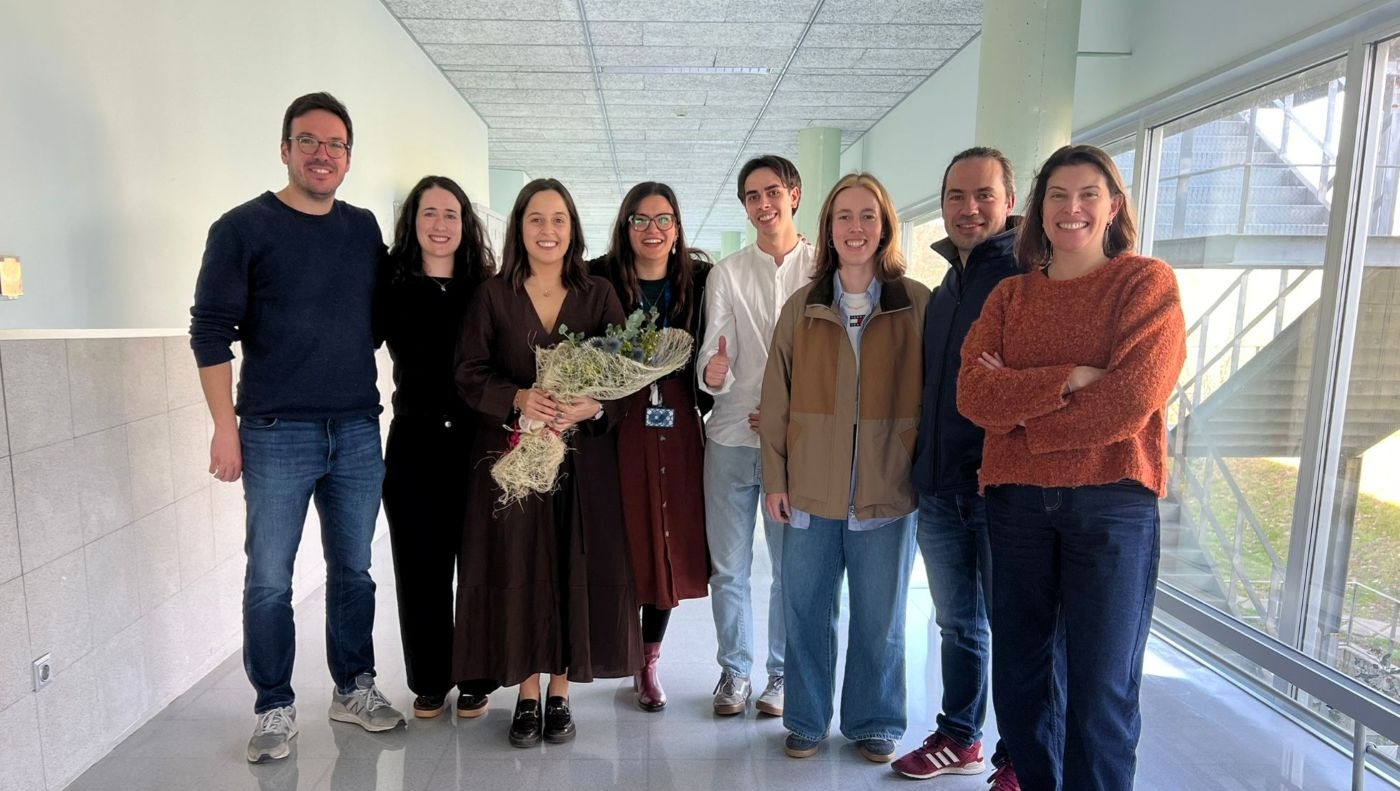
María Pazo defended her doctoral thesis, titled “Development and optimization of decentralized machine learning models in the context of sustainable mining”, a work that explores how artificial intelligence can improve decision‑making in the mining sector. The defense took place on Monday, February 23rd at the School of Mines and Energy, and the project received an International Mention, a recognition of its quality and international projection.
Her research is based on a Bayesian‑focused machine learning framework, a technique that makes it possible to manage large amounts of data and assess risks with greater precision. Thanks to this approach, it becomes easier to understand how different decisions affect not only the economic performance of a mining project but also its impact on the natural environment and on local communities. The thesis combines Bayesian networks, information theory and AutoML tools, three pillars that allow the models to “learn” from complex and distributed data more efficiently.
The work was carried out at CINTECX, within the GESSMin research group, which studies methods for more responsible mining practices. Pazo’s proposal comes at a moment when digitalization, the energy transition and advances in artificial intelligence are transforming the sector in profound ways. In this context, having models that help anticipate scenarios and reduce uncertainty has become essential for progressing towards more sustainable mining.
An approach that brings data science closer to real mining challenges
The thesis offers a tool that makes it easier to integrate dispersed information, interpret risks and make more informed decisions. In a sector where every choice carries economic, environmental and social consequences, this type of model can make a significant difference.
The research demonstrates that artificial intelligence is not only useful for optimizing industrial processes, but also for supporting complex decision‑making in a sector that is key to the energy transition.