

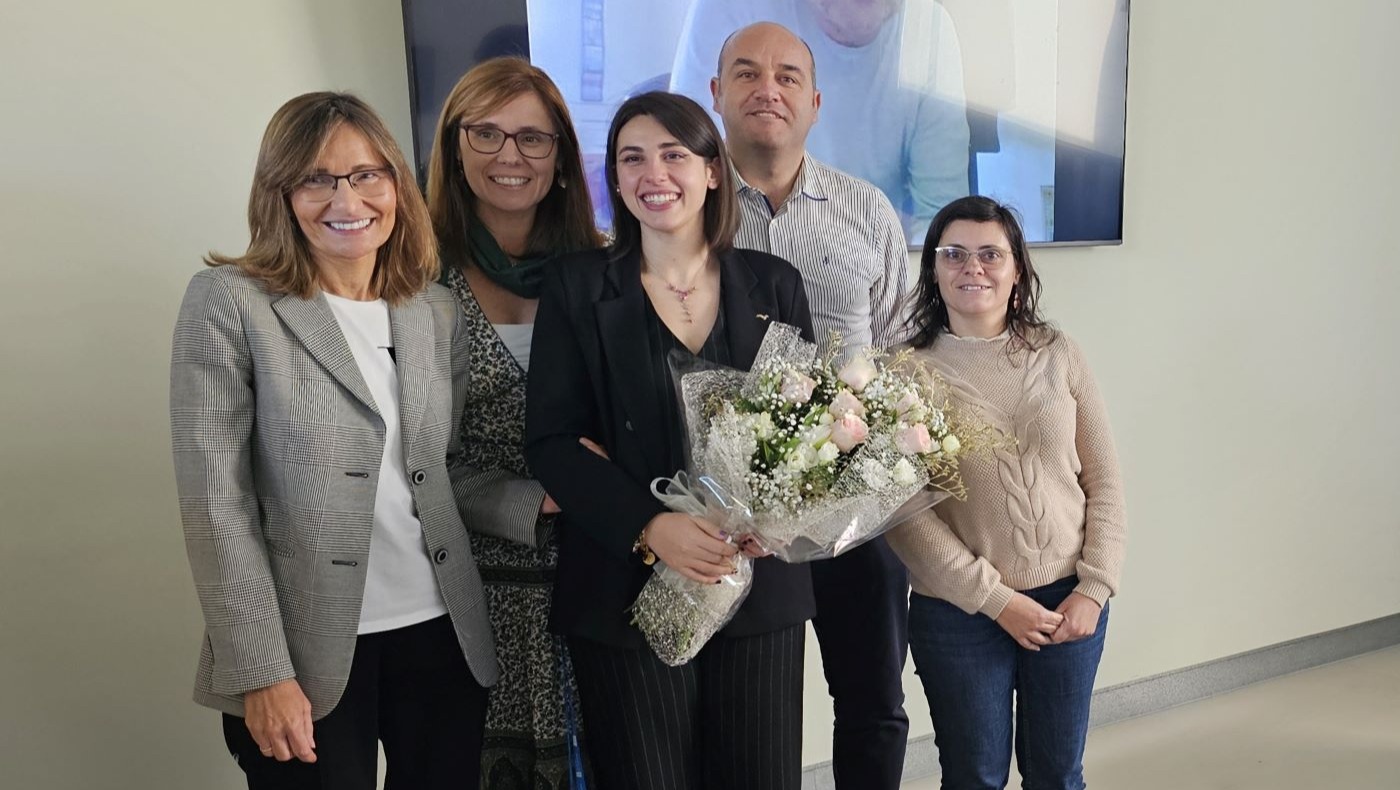
The Centre for Research in Technologies, Energy and Industrial Processes (CINTECX) has achieved an exceptional result in the Extraordinary Doctorate Awards for the 2024‑2025 academic year, obtaining three of the four distinctions granted in the field of Engineering and Architecture.
The Standing Committee of the International Doctoral School, meeting on 18 December 2025, agreed to submit to the Governing Council the proposal for the awarding of these prizes. The proposal includes Antía Fernández Sanromán, from the Mechanical and Production Technologies programme, who obtained the highest score with 92.65 points; Martín Damián Medina Sánchez, from the Communication, Computing and Electronics Engineering programme, recognised with 90 points; and Alex Alonso Díaz, from the Architecture, Civil Engineering, Construction and Urban Planning programme, who achieved 82.42 points.
Advanced catalysts for treating hospital wastewater: the thesis of Antía Fernández Sanromán
The thesis of Antía Fernández Sanromán, titled “Reduction of the environmental and health impact of hospital effluents through advanced oxidation processes”, addresses one of today’s major environmental challenges: how to effectively remove contaminants present in hospital wastewater, which often contains pathogens and pharmaceutical residues that are difficult to degrade. Her research focuses on developing catalysts capable of improving advanced oxidation processes (AOP), a technology that generates highly reactive species to destroy these compounds.
A key element of her work is the use of MOFs (Metal–Organic Frameworks), materials composed of metal ions linked to organic molecules that form extremely lightweight porous structures with a very large internal surface area. These properties make them highly versatile platforms for catalysing chemical reactions, as they can “trap” contaminants in their pores and facilitate their degradation. Fernández Sanromán evaluated both commercial MOFs and bimetallic MOFs specifically designed to efficiently activate peroxymonosulfate (PMS), a widely used oxidant in AOP.
The thesis also explores the use of graphitic carbon nitride (GCN) as a sustainable photocatalyst in hybrid processes driven by visible light. Among the most notable results, the researcher demonstrated that both mono- and bimetallic MOFs are highly effective catalysts in processes such as electro-Fenton, although their real-world application requires immobilisation techniques such as encapsulation or integration into polyacrylonitrile membranes. GCN, meanwhile, showed remarkable regeneration capacity and versatility, making it a promising candidate for the removal of pharmaceuticals through photocatalysis. Overall, the thesis highlights the importance of developing advanced catalysts to improve the efficiency and sustainability of hospital wastewater treatment.
More efficient multiphase motors for the future of electric mobility: the thesis of Martín Damián Medina Sánchez
The thesis of Martín Damián Medina Sánchez, titled “Advances on the control of multiphase AC drives under converter overmodulation”, focuses on improving the control of multiphase electric motors, a technology that offers greater reliability, higher power and smoother operation than traditional three-phase motors. These characteristics make them an attractive option for applications such as high‑power electric vehicles.
A key aspect of his research is the use of overmodulation techniques, which allow the motor’s speed range to be extended, although they often generate distortions that reduce efficiency. Medina’s research proposes new control strategies that make it possible to apply overmodulation without compromising performance.
The thesis also includes the first comprehensive comparative evaluation of these techniques in six‑phase motors, analysing current and voltage quality as well as electrical losses. His results make it possible to identify the most efficient strategies for each scenario and contribute to the development of more robust and energy‑efficient electric traction systems. This work has resulted in several high‑impact scientific publications.
Innovative solutions for more sustainable infrastructure: the thesis of Alex Alonso Díaz
The thesis of Alex Alonso Díaz, titled “Radar data integration methodologies for the evaluation of transport infrastructure and digitalization of risk”, proposes new ways to monitor and assess the condition of transport infrastructure using advanced radar technologies. In a country like Spain, with one of the largest road networks in Europe and increasingly affected by ageing and climate change, having tools that allow early detection of problems is essential.
His research combines two key techniques: InSAR, which analyses how the ground deforms over time using satellite imagery, and GPR, which makes it possible to “see” what is happening beneath the pavement surface. By integrating these with other non‑destructive methods, the thesis demonstrates that it is possible to identify subsidence, deterioration and risk areas long before they become visible.
In addition, it develops new indicators and technological improvements that increase the precision of these tools, and incorporates machine learning techniques to classify patterns and automate large‑scale analysis. The result is a methodology that facilitates the transition from reactive to predictive maintenance, making infrastructure management more efficient and sustainable, and providing administrations and technical teams with a solid basis for better road management and risk anticipation.
The three award‑winning theses address strategic challenges in sustainability, electric mobility and smart infrastructure, contributing to the advancement of knowledge and technological development in key areas for society.

Martín Medina junto a sus directores de tesis, Jesús Doval Gandoy y Alejandro Gómez Yepes
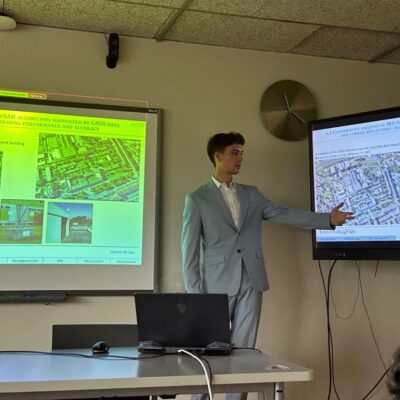
Alex Alonso Díaz en la lectura de su tesis