

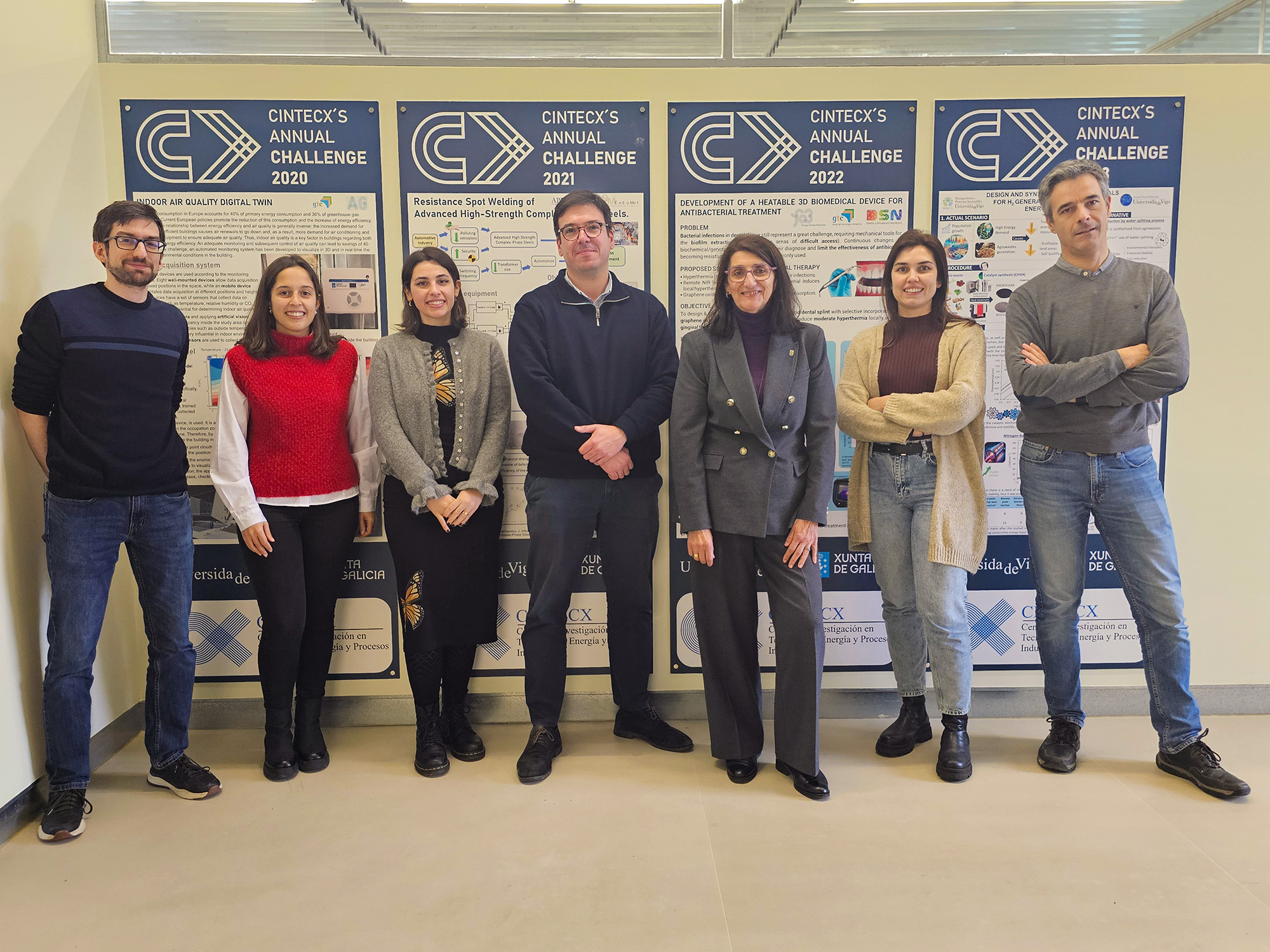
The Research Center for Technologies, Energy and Industrial Processes (Cintecx) at the University of Vigo is launching a new edition of its Cintecx Challenge, an initiative aimed at promoting the development of collaborative R&D projects among the research groups integrated in the center, with the goal of strengthening internal cohesion and enhancing the visibility of its scientific activity.
The participation period runs from December 9, 2025 to January 9, 2026, and proposals must be defended in a technical session where their quality and potential impact will be evaluated. Only two projects will be selected, each receiving €10,000 in funding, and must be carried out within a twelve-month period. Their results will be publicly presented at a dedicated event accompanied by outreach activities to ensure social visibility.
The call requires the participation of at least two Cintecx research groups in each proposal, thereby reinforcing internal collaboration and team cohesion. Projects must be led by researchers holding a PhD degree and a full-time employment contract with the University of Vigo and Cintecx until December 2026. In addition, the involvement of two postdoctoral researchers from different groups is mandatory; they will act as principal investigators with the support of their coordinators.
Winners of the 2025 Challenge: Three Ideas Transforming Science
The 2025 edition of the Cintecx Challenge produced three proposals that show how research can become real solutions for society: Eco-NanoxCat, Traconroc, and Gal-Bayes.
Led by Antía Fernández Sanromán and Pablo Pou Álvarez, the Eco-NanoxCat project focuses on creating ecological catalysts through nanotechnology. These materials act as “accelerators” of chemical processes, but with a sustainable approach: they aim to reduce environmental impact and improve energy efficiency, helping industry become cleaner and more environmentally friendly.
Meanwhile, Traconroc, driven by Ignacio Pérez Rey and Aránzazu Pintos Alonso, studies how rocks behave when subjected to tensile stress under confined conditions. This knowledge is crucial for sectors such as mining, tunnel construction, and civil engineering, where safety depends on predicting how materials react under pressure.
Finally, the third award-winning project in the 2025 edition was Gal-Bayes, coordinated by Mario Soilán Rodríguez and María Pazo Rodríguez, which focuses on artificial intelligence applied to water management. Using language models to generate Bayesian networks, it seeks to predict and optimize the use of water resources. In a context of climate change and water scarcity, this tool could become a key ally in ensuring responsible and sustainable consumption.
With these three projects, Cintecx demonstrates that collaborative research not only drives science forward but also provides practical answers to today’s major technological, industrial, and environmental challenges.