

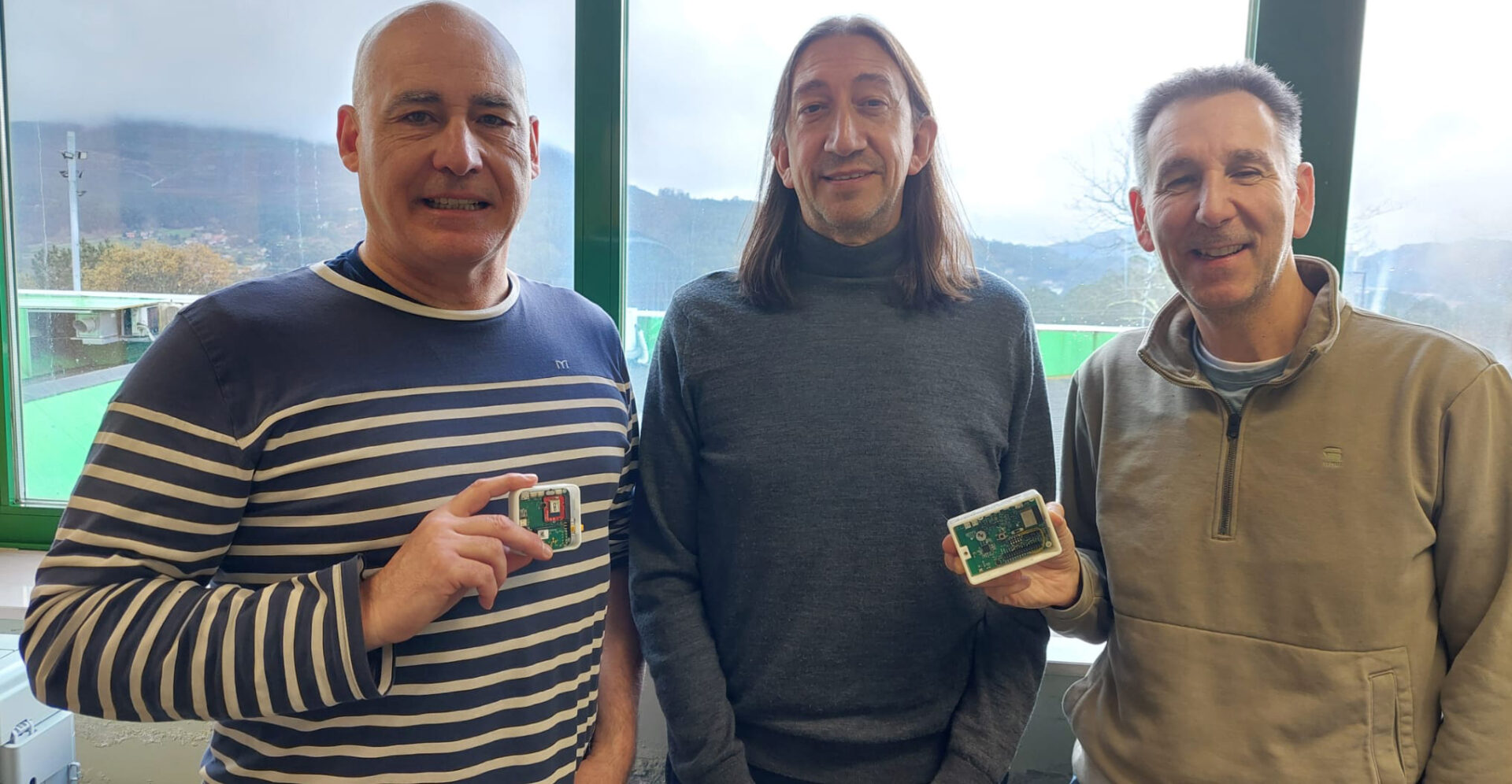
The Álvaro Cunqueiro Hospital in Vigo has become the testing and validation site for an innovative technology developed by the Energy Technology Group at Cintecx, the Research Centre for Technologies, Energy and Industrial Processes of the University of Vigo, to monitor indoor air quality in real time. The first results of the pilot project confirm the proper functioning of the system in a highly demanding environment and reinforce the hospital’s role as a benchmark in the implementation of innovation projects.
Funded through the Ignicia programme of the Xunta de Galicia with €390,000 and carried out in collaboration with the Vigo Health Area, S.C. Novo Hospital de Vigo and Veolia, the project was launched with the aim of designing new technologies capable of transforming environmental data into useful information to improve building management and people’s comfort.
Strong results in a particularly demanding environment
The pilot experience was carried out in the hospital’s Outpatient Waiting Area, where nearly 40 devices capable of collecting data every five minutes were deployed across more than 80 monitoring points. This network made it possible to obtain an accurate picture of the environmental behaviour of the space.
The data collected up to this April show stable operation consistent with air quality parameters and the standards of a state-of-the-art hospital. Average temperatures reached 23.5 °C in January and 24.0 °C in July, while relative humidity levels were 46.9% and 60.9%, respectively. Regarding air quality, average carbon dioxide levels remained at 618 ppm in winter and 630 ppm in summer, values that indicate optimal ventilation and air quality.
Beyond these figures, the system made it possible to identify opportunities for improvement in aspects such as thermal homogeneity and humidity control, demonstrating its usefulness not only for detecting problems, but also for optimising facilities that are already operating correctly.
The Cunqueiro Hospital, a key environment for validating innovation
One of the most relevant aspects of the project is the context in which it is being developed. “The Álvaro Cunqueiro Hospital is not just any environment: it is an infrastructure with very high standards in ventilation and climate control, which makes this pilot a particularly demanding test,” explains Professor Enrique Granada, project leader.
Validating a technology in a building that already functions properly is a greater challenge than doing so in spaces with obvious deficiencies. In this case, the goal is not to correct basic failures, but to demonstrate that it is possible to provide more accurate analysis, predictive capabilities and new management tools even in advanced facilities.
In this regard, the results obtained reinforce both the technical robustness of the solution and the hospital’s capacity to actively participate in applied innovation projects, as well as the willingness of the Galician Health Service to collaborate in initiatives aimed at improving the quality of healthcare environments.
Towards smarter and healthier buildings
Alongside Enrique Granada, the project team also includes Professor Pablo Eguía Oller and entrepreneur Miguel González Maquieira, co-founder of several technology-based projects. With this new technology, they are introducing a new generation of low-cost autonomous sensors equipped with advanced algorithms capable of analysing the spatial and temporal evolution of variables such as temperature, humidity and CO2. “The goal is to move towards a new generation of systems that not only measure, but also help make decisions,” stresses the project leader.
With this validation, the University of Vigo takes an important step towards bringing this solution to the market, with potential applications in hospitals, workplaces, public buildings and commercial spaces. The ambition of the project is clear: to turn indoor air quality into a real-time manageable indicator with a direct impact on people’s well-being, workers’ performance and building efficiency.